Samstag, 6. Juli 2013

Invest 95 L

No Organized Tropical Systems


The Atlantic Basin remains quiet and we expect no organized tropical weather in the near future.
There are three organized tropical waves, near 85W, between 60-65W and between 30-35W. These are all moving west and the two eastern-most waves are encountering a lot of dry air aloft.

Active showers and thunderstorms have been occurring across portions of the Gulf of Mexico this week. These have been occurring due to a persistent surface and upper-level trough interacting with rich moisture. The northern end of this trough has caused excessive rain in the past 24 to 48 hours in the Florida Panhandle, exceeding 12 inches in spots. While there have been weak areas of surface low pressures along this trough in the Gulf of Mexico, strong shear has prevented any organization. We expect that strong winds aloft will continue over this region continuing to prevent development even as the trough retrogrades to the west the next couple of days.

An upper-level low now near 23N, 60W is moving west-southwest with a small area of showers and thunderstorms ahead of it. All models continue to move this low underneath the ridge that exists in the western Atlantic with this low approaching the northern Bahamas/southeastern Florida on Monday, then moving across Florida on Tuesday/Wednesday. There is nothing at this point indicating any tropical surface low development with this feature, but it could enhance showers and thunderstorms over portions of Florida next week.

Donnerstag, 4. Juli 2013

Wetterinfos online


Large Satellite Animations from NOAA/NESDIS and Others


Real-time Tropical Imagery


Computer model forecasts


Rain information


Aircraft Reconnaissance Sites


Mittwoch, 3. Juli 2013

100 % mas lluvia

Cinco provincias registraron lluvias superiores al cien por ciento.


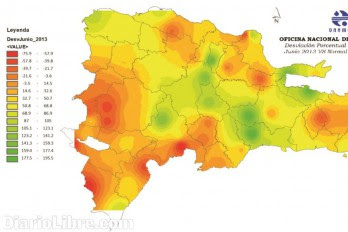
 El Gran Santo Domingo, Hermanas Mirabal, Monte Plata, La Vega y Monseñor Nouel tuvieron el pasado mes de junio, lluvias que superaron en el cien por ciento los valores normales que reciben para esta fecha, según un análisis suministrado por técnicos de la Oficina Nacional de Meteorología.

Así, por ejemplo, la estación meteorológica de Santo Domingo registró 224.6 milímetros, mientras su valor promedio para junio es 116.4 milímetros. En el registro de lluvias del mes de junio se indica que la zona donde más llovió fue Yamasá, en Monte Plata, con 522.1 milímetros de agua (la precipitación normal para junio es de 191.9 milímetros).

El valor que presenta Yamasá es extremadamente alto, pues como explica Bolívar Ledesma, encargado del Departamento de Meteorología General de Onamet, una zona que reciba 40 milímetros de lluvia por hora, ya es inundable. Un milímetro es equivalente a un litro de agua por metro cuadrado. Otros territorios que superaron su desviación porcentual de precipitaciones para este mes, son Sabana de la Mar (494.8 mm), Montecristi (272 mm) y San Cristóbal (228.7 mm).


Donde menos llovió

Las zonas que recibieron valores de lluvia por debajo de lo normal fueron Pedernales, Azua, Punta Cana, Jimaní, San Juan de la Maguana, Elías Piña, Hato Mayor y San Francisco de Macorís. Además, se destacaron desviaciones por debajo de lo normal e inferiores al 60% en Pedernales, Azua, Punta Cana y Jimaní.


Montag, 1. Juli 2013

Nueve provincias y el Gran Santo Domingo en alerta verde contra inundaciones

EN VILLA RIVA HAY UNA COMUNIDAD AISLADA Y EN LA BARQUITA 25 VIVIENDAS RESULTARON AFECTADAS POR LA CRECIDA DEL RÍO OZAMA


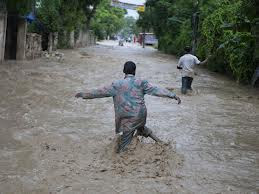
El Centro de Operaciones  de Emergencias (COE) emitió alerta verde para nueve provincias y el Gran Santo Domingo, ya que continuarán los aguaceros las próximas 24 horas por  una onda tropical que incide  sobre el país.
Asimismo, informó que por las inundaciones  está  incomunicada la comunidad Los Contreras, en Villa Riva, en la provincia Duarte, por la crecida de los ríos Yuna, Payabo y Caño Azul.
Mientras que en Santo Domingo Este, en el sector La Barquita,  se reportaron 25 viviendas afectadas por la acrecida del río Ozama.
Las provincias en alerta son Monte Plata, Duarte (en especial El Bajo Yuna), San Cristóbal, La Vega, San Pedro de Macorís, La Altagracia, Monseñor Nouel, María Trinidad Sánchez, Sánchez Ramírez, y el Gran Santo Domingo.
El COE recordó a la población seguir los lineamientos y orientaciones de los organismos de protección civil y a los residentes en zonas de alto riesgo, que habitan próximo a ríos, arroyos y cañadas tomar en cuenta las medidas de precaución.